
How to slow down corrosion?
It is very commonly said that corrosion is prevented, but in fact it is more a matter of slowing corrosion down. Fortunately, you do not have to climb onto the roof all that often, since with a sheet metal roof the interval between the necessary slowing-down measures can be more than 20 years if the roof is well designed and installed.
Usually, the aim of these measures is to prevent water contact with paint or to use a controlled sacrificial protective metal, most commonly zinc. The most effective measures use both.
How corrosion is slowed down by painting
If there is no water on the surface of the steel, there is no corrosion. A coat of paint is intended to prevent water from reaching the metal surface. In practice, it does not do that, but only slows water’s access to the metal surface. A water molecule is such a tiny little thing that it weaves its way through the microscopic pores in the paint. Once you know this fact, you also understand the importance of properly preparing the metal surface and using a functioning primer. They slow down the progress of the little things and keep them under control when they reach the metal surface.
If you want to do the painting well, it is worth knowing:
- The better the paint adheres to the metal, the better. That is why primer is applied.
- The thicker the coat of paint, the better, within reason.
- Two thinner coats are better than one thick one: the water molecule little things have a more difficult route.
- The better the corrosion-slowing agents in the pretreatment and especially in the primer, the better.
- The denser the material the paint is, the more difficult it is for the little water things to get through.
- What the atmospheric corrosivity category is in and around the building => the right paint system. In Finland, C3 durability is sufficient.
- Paints have a certain service life and a corresponding need for repainting. Do it in time, and you will have less to deal with.
How corrosion is slowed down with zinc
Often, a steel surface cannot be protected safely enough with paint alone, in which case a metal that sacrifices itself for the steel is used. Zinc protects steel well in most natural environments, and on the other hand it itself corrodes slowly under normal atmospheric exposure. That is why it is an excellent helper.
If damage extending all the way to the steel occurs on a galvanized steel surface, the steel and zinc form a galvanic couple in the presence of water. The zinc dissolves slowly, protecting the steel from rusting. (image below)
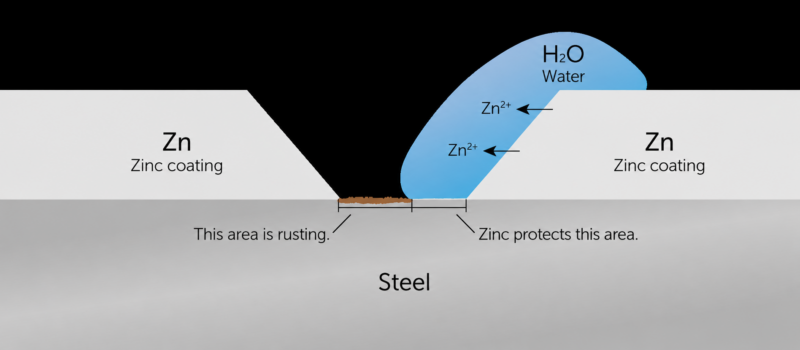
Zinc protects only when it has water and electrical contact with the steel. The tiny droplets of humidity cannot form a continuous water bridge between the zinc and steel, which is why, for example, even 80% humidity without visible water causes a veil of rust to form on the surface of damaged steel. In this case, very light rusting takes place beneath lifeless humidity droplets that are not in contact with one another. The corrosion rate is then quite negligible, and the problem is more visual (= the color of the rust) than structural (= corrosion of the sheet metal).
When zinc and paint are used wisely, corrosion can easily be slowed down for a generation.
Jorma Kinnunen