
Beware poor fasteners
Sheet-metal roofing and its fasteners are constantly exposed to the weather. Metal roofs have been fastened either with nails or screws. A poorly coated fastener head rusts easily, or the roof leaks if a poor-quality fastener rises away from the sheet. What kind of fastener withstands demanding conditions best?
How do roofing nails work?
I have examined fasteners removed during roof renovations, which Hämeen Laaturemontti collected according to my instructions. The installers gathered as much information as possible from the roof owners about the history of the roof and fasteners.
The renovation sites were mainly roofs over 30 years old, most of which had already been leaking for some time. The old roofs had originally been fastened mainly with nails, because the use of screws was practically nonexistent over 30 years ago. The collected fasteners included screws that had replaced nails that had failed in their task; the screws had been installed in place of detached and leaking nails.
Of the nails, the type that had clearly worked best was one with a large washer with a good seal and a strong ribbed pattern on the shank to prevent it from rising. The shank of these nails had suffered very little from moisture, because the nail had not risen and the seal had not leaked.
The nails in the worst condition, in turn, were those with only small seals without a metal component and a fairly smooth shank. The seals had possibly broken already during installation, and the nails had risen as the roof moved with changes in temperature and moisture.
What condition are roofing screws over 20 years old in?
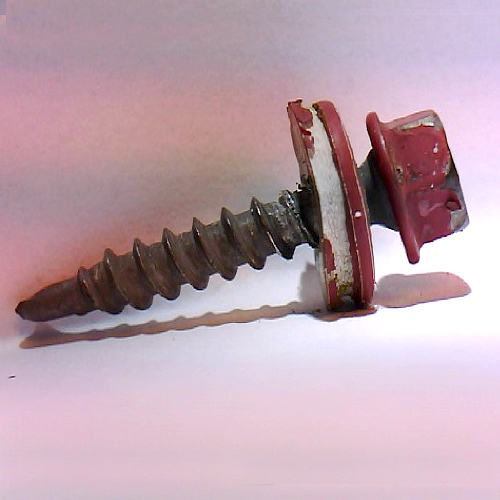
A high-quality screw from the overlap joint of the sheets. Apart from the paint on the head, the screw is in good condition.
Since hopefully nobody fastens sheets with nails anymore, it was next appropriate to focus on examining the behaviour of roofing screws more closely. I had followed the behaviour of different screws at test installation sites, but for a more detailed study I wanted a sufficiently old and reliably documented site. One was found very close indeed, right above my head. The roof of my own house in Hämeenlinna is 26 years old, the roof pitch is 1:3 and the roofing is Eliitti profile roofing. Ventilation in the roof space has not been very good, but it has been sufficient. The general atmospheric corrosivity category in the residential area is relatively mild C3. The house has a chimney, which is used for burning birch logs fairly often from autumn to spring.
I took the screws to be examined from the northern roof slope, because three different screw types had suitably been used there under similar atmospheric exposure. One of them was a drill-point screw that had come with the profiles in the year of installation, 1989, and was known at the time as the best on the market. In addition to the original installation screw, two different sharp-pointed screws purchased from a hardware store had been used in the installation.
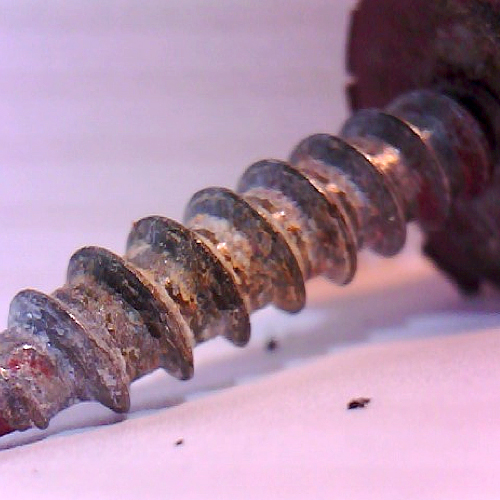
The shank/body of the screw in the previous image in more detail. The shank/body has a slight layer of white rust and is partly covered with wood residue (comes off by scraping).
According to the sales pitches, all the screws were in principle similar in terms of durability, but the original installation screw had performed best in corrosion tests carried out by Ruukki. Some of the screws had been used to fasten the bottom of the profile to wooden battens and some in the longitudinal overlap joint of the profiles, on top of the profile. An overlap-joint screw breathes the air beneath the sheet, while a screw in a wooden batten is protected by dry wood. If the wood is not dry, there are also mould and structural durability problems in addition to corrosion of the screw.
When I examined the roofing screws after 26 years of use, the original installation screw proved clearly the best. Apart from the paint coating on the head, it was in good condition. Snow that had slid down from the roof had mechanically worn the paint surface on the ridge side, that is, from the direction the snow came from, and the paint came off the screw head fairly easily by scraping. Near the chimney, the snow had detached the paint from the screw heads, which were already heavily rusted. The body of the screw beneath the sheet had only a very light layer of white rust.
The bodies of both sharp-pointed hardware-store roofing screws were in as good condition as the original installation screw, but the durability of the washers and heads was clearly weaker in these.
The metal component of one screw’s washer was aluminium and that of the other was galvanised steel. With the galvanised washer, water had reached the edge of the washer, creating a galvanic couple between the zinc and steel. As a result, the zinc corroded rapidly, detaching the EPDM from the metal component. The screw was no longer watertight. The aluminium washer also appeared to be badly rusted, but closer examination showed that the rust had run from the screw head and become embedded in the washer. The EPDM seal of the washer was still fairly firmly attached to the aluminium metal component.
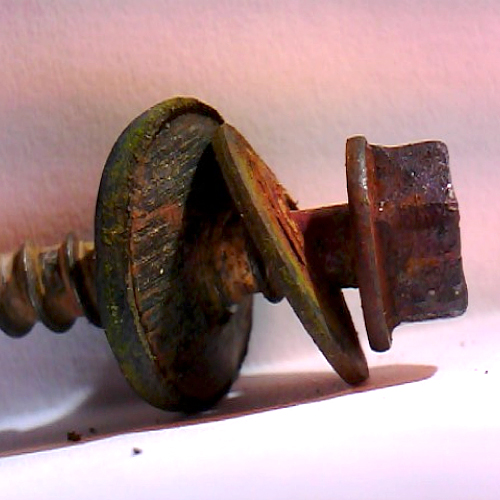
Poor-quality hardware-store screw no. 1 that had been fastened into a wooden batten. The head is heavily rusted, the seal has detached from the washer and the metal component is rusted. The body is in good condition.
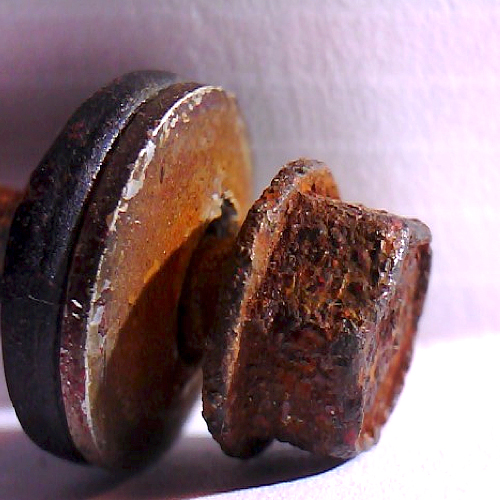
Poor-quality screw no. 2 that had been in a wooden batten. The washer is aluminium, which is why the EPDM seal is firmly attached. The body is in good condition. The head is extremely heavily rusted, and rust from the head has adhered to the aluminium washer.
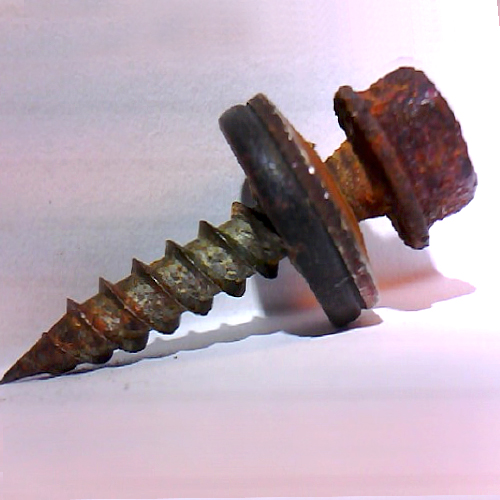
Poor-quality screw no. 2 that had been in a wooden batten. The head is extremely heavily rusted. The washer is aluminium, which is why the EPDM seal is firmly attached. The body is in good condition.
The heads of both sharp-pointed hardware-store roofing screws were completely covered in rust, more severely in the screw with the aluminium washer.
All screws that had been fastened into wooden battens had brown wood residue on the body, which looked like rust but came off by scraping, revealing a bright metal surface underneath.
What kind of roofing screw lasts?
1. The body is electroplated carbon steel
As the basic material of the screw, 12-micrometre electroplated carbon steel is certainly durable.
Why? By combining all the results of the follow-up studies, it can be concluded that roofing screws were already manufactured 26 years ago whose bodies have remained in good condition all these years, whether they were in wooden battens or in an overlap joint on the ridge of the sheet-metal profile. The bodies of the screws in the study were electroplated carbon steel. According to the standard SFS EN 1995-1-1 concerning the screw body, the electroplating must be 12 micrometres in wooden batten fastening.
2. The washer is marine-grade aluminium and EPDM rubber
In washers, a marine-grade aluminium metal component together with a proper EPDM seal ensures the watertightness of the fastener.
Why? According to studies, a galvanised washer does not appear to last, and a stainless steel washer must not be used because of the risk of galvanic corrosion. In any case, nobody would use one because of the high price. In areas exposed to chlorides, such as coastal areas or areas where combustion gases spread, only a washer made of marine-alloy aluminium will last.
3. The screw has electroplating and a three-layer coating
The screw’s coating must have at least 12 micrometres of electroplating, good pretreatment and, on top of it, a sufficiently thick primer and topcoat.
Why? According to studies, the coating of the roofing screw currently in general use is mainly a decorative coating, because it does not withstand the challenging conditions of metal roofs. According to building regulations, the paint coating of a roofing screw must last as long as the coating of the metal roofing itself, so the roofing screw should be coated with an equally good coating system.
If you want your metal roof to last as long as possible, check that the coating of the roofing screws is ETA-approved for at least atmospheric corrosivity category C4 and that the manufacturer credibly promises sufficiently long warranties for it. Do not use any of the CE-marked nonsense screws currently in use, whose head coating system is more a decorative than an anti-corrosion coating and whose “warranties” are not credible. You can easily check the atmospheric corrosivity classification of the screws in the screw’s Declaration of Performance (DoP) or European Technical Assessment (ETA). According to current regulations and building regulations, the screw’s atmospheric corrosivity classification can be checked only from these two documents; all other documents and statements are misleading.
4. The screw is easy and reliable to install
Why? During installation, a poor screw causes considerable damage to the durability of both the screw and the sheet. The paint peels from the head of a poor screw already during installation, and the screw drills poorly, often causing scratches on the surface of the sheet. When the protective layer of paint is lost, rust, additional maintenance and a shortened roof lifespan take its place.